

That feeling you can’t quite explain
It is 2pm. You have read the same sentence three times and it still has not landed. Your stomach feels off in a way you would not call sick, just unsettled. You are tired, but a particular kind of tired, the kind where your body is exhausted and your mind will not slow down. Wired and tired at the same time.
You have probably filed these as separate problems. The fog is a focus problem. The stomach is a digestion problem. The restlessness is a stress problem. Three things, three explanations, three things to fix.
What if they are not three problems? What if they are one system, talking to itself, and you have been hearing only one side of the conversation at a time?
This is the question the gut-brain axis answers. It is one of the most active areas in modern health science, and once you understand it, a lot of the things you have learned to live with start to make a different kind of sense.
What the gut-brain axis actually is
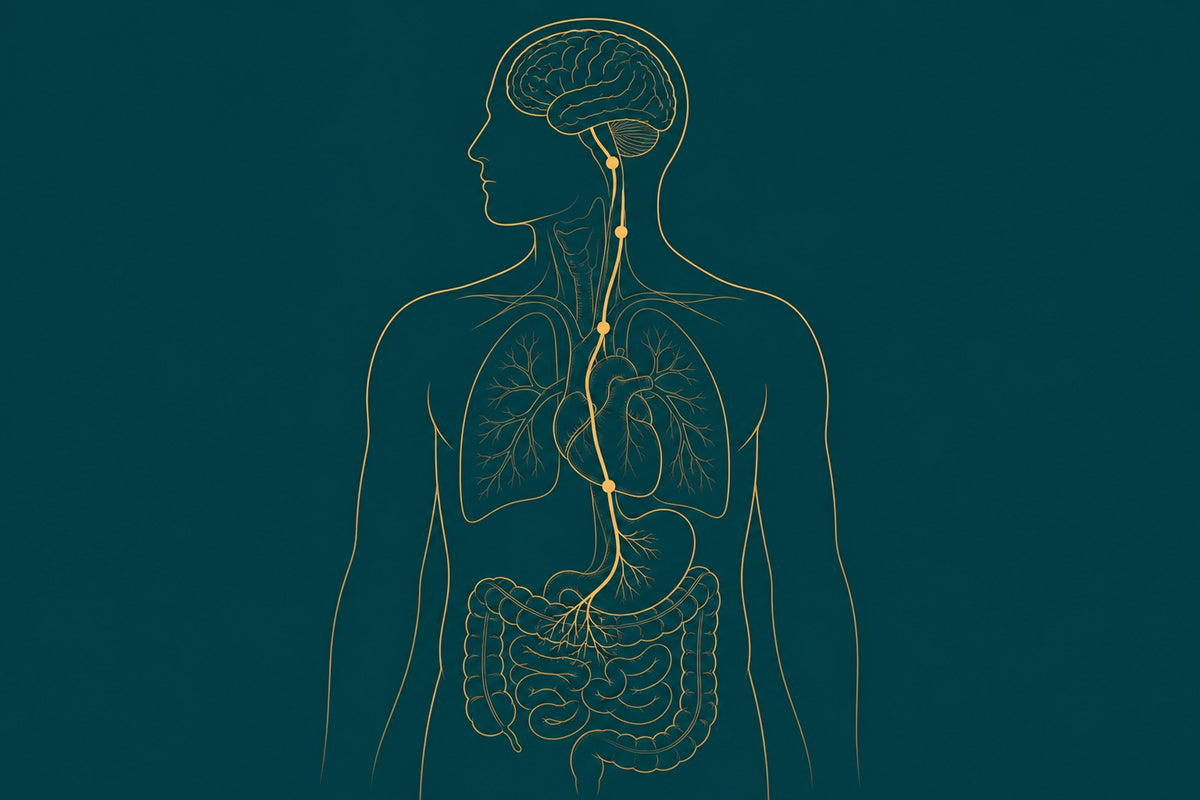
The gut-brain axis is the two-way communication network that connects your digestive system and your brain. Not a metaphor. A physical, measurable set of pathways that carry signals in both directions, all day, whether you notice it or not.
There are three main channels in this conversation:
The vagus nerve. This is the direct neural line. The vagus nerve is the longest of the cranial nerves, running from your brainstem all the way down to your abdomen, touching nearly every major organ on the way. Here is the part that surprises most people: roughly 80% of its fibers are sensory, carrying information from your internal organs, including the gut, up to the brain (Bonaz et al., 2018, Frontiers in Neuroscience). Your gut is doing far more talking than listening.
The chemical channel. Your gut bacteria are not passive passengers. They manufacture and influence neurotransmitters, the same signaling molecules your brain uses. Around 90-95% of the body’s serotonin is produced in the gut (Yano et al., 2015, Cell), and gut bacteria also influence the production of GABA and dopamine. The chemistry of how you feel is, in part, gut chemistry.
The immune and inflammatory channel. The lining of your gut is one of the largest interfaces between your body and the outside world, and it is densely populated with immune cells. The state of your gut influences low-grade inflammation throughout the body, and inflammation is increasingly linked to how clearly you think and how steady your mood is (Cryan et al., 2019, Physiological Reviews).
Put those three channels together and you get a system where what happens in your gut genuinely shapes what happens in your head, and vice versa.
Why scientists call the gut your “second brain”
The phrase “second brain” gets thrown around loosely, but it has a real basis. Your gut contains its own nervous system, the enteric nervous system, with an estimated 200 to 600 million neurons (Furness, 2012, Nature Reviews Gastroenterology & Hepatology). That is more neurons than your spinal cord. This network can operate many digestive functions on its own, without waiting for instructions from the brain.
So when people say their gut is “telling them something,” they are closer to the biology than they realize. The gut has the hardware to generate signals and the wiring to send them upstairs.
How this shows up in real life
The science is interesting, but you came here because of how you feel. Here is how the gut-brain axis maps onto the things you actually notice.
Focus and clear thinking. Research connects the diversity and balance of the gut microbiome to cognitive performance in healthy adults. In one randomized controlled trial, a specific probiotic strain, Lactobacillus plantarum DR7, was studied in 111 stressed adults over 12 weeks, and the treatment group showed improved scores on measures of processing speed and attention, with the clearest effects in older participants (Chong et al., 2019, Beneficial Microbes). This is about the speed and steadiness of thinking, not memory capacity, and the effect built over weeks of consistent use, not overnight.
Mood and emotional steadiness. Because so much serotonin signaling involves the gut, the state of your microbiome is associated with emotional regulation (O’Mahony et al., 2015, Behavioural Brain Research). This is correlation and mechanism, not a promise: no supplement treats a mood disorder, and anyone struggling should talk to a clinician. But the link between gut and mood is real and well-documented.
Sleep and the nightly wind-down. The gut-brain axis is tied into your circadian rhythm, the internal clock that governs when you feel alert and when you feel ready to rest. Disruption on the gut side is associated with disruption on the sleep side (Li et al., 2018, Frontiers in Psychiatry).
Digestive comfort. This one is the most direct. When the gut environment is supported, with the right fibers feeding the right bacteria, the felt result is often simple, ordinary comfort. One well-studied prebiotic fiber, galactooligosaccharides (GOS), significantly reduced bloating, abdominal discomfort, and flatulence within the first week of use in a crossover trial that randomized 91 adults selected for those symptoms (83 completed it) (Vulevic et al., 2018, Neurogastroenterology & Motility).
Notice the pattern. Focus, mood, sleep, digestion. These are not four unrelated systems you have to manage separately. They are four windows onto one connected system.
What the research shows, and what it doesn’t
It would be easy to overstate this. The internet is full of confident gut-health claims that the evidence does not support, and you have probably learned to distrust them. So here is the honest version.
What the research supports with growing confidence: the gut and brain communicate through multiple well-mapped pathways; specific, named probiotic strains have produced measurable effects on stress response, cognitive speed, and digestive comfort in randomized controlled trials; and pairing a clinically studied probiotic strain with a prebiotic fiber, a combination called a complementary synbiotic, brings two independently studied ingredients to the same system. The pair has not been tested together in a human trial, so each is described on its own evidence.
What the research does not yet support: precise mechanisms for every strain, optimal long-term dosing protocols, or any claim that a supplement treats, cures, or prevents a disease. The field is young. Most individual studies are small to moderate. Strong directional evidence is not the same as a single definitive trial, and any brand that tells you otherwise is selling you certainty it has not earned.
That honesty is the point. If the gut-brain axis is going to be useful to you, it has to be described accurately, including its limits.
What this means for what you take
If the gut-brain axis is one connected system, then it makes more sense to support both ends of it than to treat each symptom in isolation.
Most probiotics are built for digestion alone. They ignore the brain side of the axis entirely. And most “brain” supplements ignore the gut. A gut-brain approach does something different: it pairs clinically studied probiotic strains with ingredients that support calm focus and relaxation, so the formula works with the biology of the axis instead of against one end of it.
There is also a timing logic here. Your brain needs different support at different times of day. In the morning, the goal is calm, clear focus, the kind that holds without jitter. At night, the goal is to wind down and rest well. A protocol built around the gut-brain axis can split along that natural rhythm, supporting calm focus in the morning and relaxation in the evening, with the same gut-brain foundation running underneath both.
That is the idea behind a day-and-night gut-brain protocol, and it is where the science stops being abstract and starts being something you can actually use.
The bottom line
The gut-brain axis is real, well-documented, and quietly important. If you have been treating brain fog, an unsettled stomach, and restless nights as three separate problems, the research suggests they may share a common root in the conversation between your gut and your brain.
Understanding that connection is the first step. The next is choosing support that respects it: clinically studied ingredients, at the doses the studies actually used, designed for the gut and the brain together rather than one in isolation.
Frequently asked questions
What is the gut-brain axis in simple terms? The gut-brain axis is the two-way communication network connecting your digestive system and your brain. They exchange signals constantly through the vagus nerve, through neurotransmitters that gut bacteria help produce, and through the immune system, which is why the state of your gut can influence focus, mood, and sleep.
Can gut health really affect brain fog and mood? Research suggests a strong link. Around 90-95% of the body’s serotonin is produced in the gut, and the diversity of the gut microbiome is associated with cognitive performance and emotional steadiness in healthy adults. This is an association supported by mechanism and clinical studies, not a claim that any supplement treats a medical condition.
Why is the gut called the “second brain”? Because it contains its own nervous system, the enteric nervous system, with an estimated 200 to 600 million neurons, more than the spinal cord. This network can run many digestive functions independently and sends a large volume of signals up to the brain.
How long does it take to support the gut-brain axis? It depends on the outcome. Some prebiotic fibers support digestive comfort within the first week of consistent use, while cognitive and stress-related effects in clinical studies tended to build over several weeks. Consistency matters more than any single dose.
What is the difference between a probiotic and a gut-brain supplement? A standard probiotic is built for digestion alone. A gut-brain supplement pairs clinically studied probiotic strains with ingredients that support calm focus or relaxation, so it supports both ends of the gut-brain axis rather than only the digestive side.
